
Subscribe to continue reading
Subscribe to get access to the rest of this post and other subscriber-only content.

Subscribe to get access to the rest of this post and other subscriber-only content.
If you’ve been on TikTok lately, you’ve probably noticed a resurgence of a 70s disco classic. Anita Ward’s “Ring My Bell” is having a moment, but not just because people are rediscovering its funky charm. The track is being repurposed as a manifestation tool.
Users claim that listening to the song or using its sound helps them attract abundance, energy, and positive vibes. At first, it’s easy to write this off as just another social media trend. But it got me thinking about something I’ve explored on this blog before: the science and spirituality of musical tuning.
Why this song? Why now? I had a theory: What if the frequency of the track itself is what’s making it feel so “powerful”?
For years, I’ve been fascinated by the difference between the standard A=440 Hz tuning and the slightly higher A=444 Hz (often associated with the “Scientific” or “Verdi” tuning, believed by some to have a more resonant, healing quality).
Listening to “Ring My Bell” with fresh ears, something stood out. The track sounds… bright. Energetic. Slightly sharp compared to modern pop. I grabbed my tuner to test it on the fly, and my hunch seemed correct: It was leaning toward the 444 range rather than the standard 440.
But I wanted hard data. So, I decided to turn to an unlikely analysis partner: Gemini AI.
I asked Gemini to analyze the track’s signature sound and historical context. The results were fascinating and confirmed my suspicions.
According to the AI’s digital frequency analysis, Anita Ward’s “Ring My Bell” doesn’t sit at the standard concert pitch we use today. Instead, it hovers around 444 Hz to 445 Hz.
Here is the breakdown of why a 1979 disco track might feel so “sharp” and why that might matter for manifestation:
In the late 70s, producers often used a technique called varispeed. By slightly speeding up the master tape (even by 1-2%), they could make a track sound brighter and more energetic for the dance floor. “Ring My Bell” is a victim (or beneficiary) of this technique, pushing it away from 440 Hz and toward that higher, shimmering 444 Hz range.
The AI compared the track to a standard pitch:
That 15-20 cent difference is subtle to the untrained ear, but noticeable to the subconscious. It creates a feeling of heightened energy and “brilliance”—exactly the kind of sensation you want when trying to raise your vibration for manifestation.
And what about that iconic “pew-pew” electronic drum sound? The AI pointed out that it’s a frequency sweep, starting high and dropping rapidly. While it doesn’t have a static tuning, it contributes to the overall “high-frequency” atmosphere of the production.
The TikTok community is using the song to “ring the bell” of abundance. Whether you believe in the metaphysical power of 444 Hz or not, the data is clear: This song is tuned higher than usual.
If you subscribe to the idea that higher frequencies (like 444 Hz) promote clarity, positivity, and spiritual alignment, then “Ring My Bell” is accidentally the perfect manifestation anthem. It’s a disco track that literally vibrates at a higher rate than the music we hear today.
If you want to feel the “tuning” difference for yourself, try this:
Whether it’s intentional magic or just analog tape drift, it seems the internet has accidentally stumbled upon a scientifically sharper frequency to fuel their intentions.
What do you think? Is 444 Hz the secret sauce to the song’s viral manifestation success? Let me know in the comments.
Subscribe to get access to the rest of this post and other subscriber-only content.
For years, I’ve followed the pioneering work of Sonia Rinaldi. When I first discovered her, she was deeply immersed in Electronic Voice Phenomenon (EVP)—a field I was only beginning to explore. Like many, I was moved by stories of spirit contact and the quiet persistence of those who listen beyond the veil.
Around that same time, I was experimenting with what I called “projection photos.” I’d project an image of Prince onto a wall and pose beside it, capturing a kind of spiritual duet in self-portraits. One day, something extraordinary happened: during one of these sessions, Prince’s image appeared on camera not as a flat projection on the wall, but as a translucent overlay—a spectral layer superimposed directly over my own form.
That experience sparked an idea: what if we could use projection and steam as a medium for spirit imagery? As a former art student, I’d worked with projections and installation art, so the concept felt like a natural extension of my creative exploration. I imagined a spherical chamber filled with mist, shaped by multiple projectors to capture fleeting forms. I never built it—but the idea stayed with me, lingering in the back of my mind like an unfinished sketch.
Read more of this content when you subscribe today.
Subscribe to get access to the rest of this post and other subscriber-only content.
For this Valentine’s Day, I’m gifting my readers a collection of affirmations for self-love. Before a heart can truly recognize another, it must first learn to beat in its own rhythm of worth. This is the sacred prelude: the love we are able to receive from the world, or from beyond it, can only ever meet the depth of the love we have nurtured within ourselves. To be whole for another—in this life or any other—we must first gather every scattered piece of our own soul and call it home.
How to Use Them:
Start with one or two that feel true, even if just a little. The more you repeat them, the more your mind will believe them. You are worthy of this love.
For more on the subject of Self-love, I’ve shared an excerpt from my unreleased memoir in the Library.
For this Valentine’s Day, I’m sharing an excerpt from a manuscript I’m currently working on. It begins with a simple, vital truth: every love that transcends time and space originates from the love we hold for ourselves. Before we can recognize a love that nurtures rather than diminishes us, we must first become whole within. The love we are able to accept from others will only ever be as deep as the love we’ve cultivated within.
Read more of this content when you subscribe today.
Subscribe to get access to the rest of this post and other subscriber-only content.
For years, I fought a battle I never asked for. It was quiet, exhausting, and fought in a place that I never thought that I’d step foot in: a courtroom.
My parents own a condo, and the condo board got nasty.
For months, it was my secret second job. Researching case law late into the night. Drafting affidavits. Preparing to face a lawyer in a courtroom where I had no formal right to be. I learned that the system isn’t just complex—it’s a game. And the players who know the rules hold all the power.
I won that battle. My parents kept their condo. But the story was too important, and the lessons too hard-won, to keep to myself.
So, I wrote a novel.
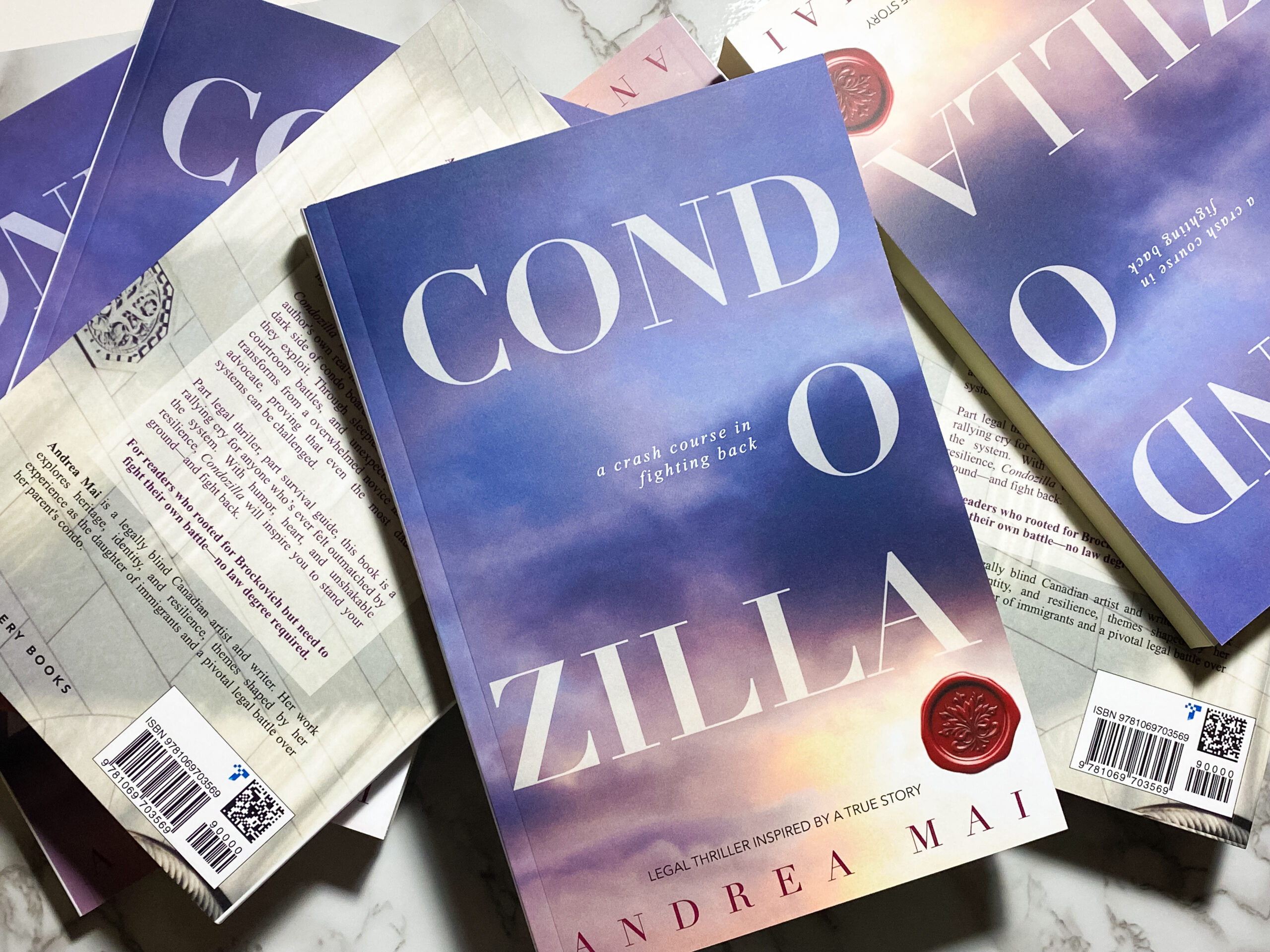
Condozilla is a work of fiction, but its heart beats with the absolute truth of that experience. It’s the story of Clara Chang, a woman who must become her own mother’s lawyer to fight a powerful, vindictive condo board. It’s about the “us vs. them” of everyday life, the shock of seeing a system weaponized, and the sheer stubbornness it takes to stand your ground.
I changed the names and details to protect the innocent (and the not-so-innocent), but the emotional journey, the strategic fight, and the damning evidence are as real as it gets.
Because the fight wasn’t just about legal paragraphs. It was about fear, family, and the slow-burning rage of injustice. A novel lets me share the feeling of it—the sleepless nights, the shaky hands in the courtroom, the small, hard-won victories that keep you going. It lets you walk in Clara’s shoes, not just read her legal arguments.
But for those looking for the roadmap, it’s all there. Woven into the story and detailed in a practical appendix, you’ll find the real strategies, resources, and mindset that can turn the tide.
Funnily enough, it was movies and pop culture that gave me the soundtrack and the spirit to fight. (You might spot a few references in the book).
I’m still new with self-publishing as an author, so I am trying out different ways to sell my work. I have it available as an ebook in PDF format, or on Amazon as a kindle book or in paperback print edition. My royalty cut is much better for the PDF version, but I understand that Amazon is more accessible to readers.
Do you know someone facing a bully, a bureaucracy, or a broken system? Share this with them. It might be the encouragement they need to to fight back.
Next week, I’ll be posting the first chapter of Condozilla here on the blog. You’ll need to be a subscriber (free tier is perfect!) to read it, so be sure to sign up.